In early 2024, I was drowning in digital notifications. I had four different banking apps and three subscription trackers. My phone buzzed every time I spent a dollar. Instead of feeling in control, I felt overwhelmed. The digital friction made me want to ignore my money entirely. One Tuesday night, I deleted the apps and bought a simple dotted journal. I decided to return to the basics of paper and pen.
That decision changed my entire relationship with wealth. By 2026, the world has become even more digital. We are surrounded by AI and automated everything. Yet, the act of physically writing down a number does something to the brain that a screen cannot replicate. It creates a neural connection between your goals and your actions. This tactile experience turned my budget notebook from a chore into a creative ritual.
If you are tired of staring at screens and want a system that actually sticks, you are in the right place. This guide covers 14 budgeting notebook ideas that range from strictly functional to artistically inspiring. Whether you want an aesthetic budget tracker or a minimalist budget layout, these strategies will help you achieve financial peace. We will explore tools like Zebra Mildliners to make your DIY budget journal a masterpiece.
1. The Bullet Journal Cash Flow Method

The bullet journal budget is the ultimate flexible system. Unlike pre-printed planners, a blank dotted journal allows you to change your layout every month. I started using this method in 2024 when my income was irregular. I needed a way to track freelance checks alongside my fixed salary. I created a dedicated index for my money pages.
In this layout, I use a simple vertical list for daily expenses. On the left side, I write the date and the item. On the right side, I list the amount. At the end of the week, I total the categories. This provides immediate feedback on my spending habits. I found that seeing a long list of small purchases was more convicting than seeing a single total on an app.
The beauty of the bullet journal budget is that it grows with you. If you start a side hustle, you just add a new page. If you are saving for a house down payment, you can draw a custom tracker. For those just starting, I suggest checking out my how to budget for beginners guide. It will help you define the categories you need to track in your journal.
2. Minimalist Monochrome Layouts for Clarity

Sometimes, less is more. I went through a phase where I used too many colors and stickers. It became a distraction. I switched to a minimalist budget layout using only a black pen and a grey highlighter. This removed the “performance” aspect of journaling and focused entirely on the data.
A minimalist spread usually consists of four boxes: Income, Fixed Bills, Variable Spending, and Savings. I use thin lines to separate the sections. This clean look helps me focus on the bottom line without the mental clutter of decorations. It is a perfect choice for busy professionals who want the benefits of paper without the time commitment of art.
I use a Moleskine classic notebook for this style because the paper handles fine-liner pens perfectly. If your goal is strictly managing your money with speed, this is your best option. You can see how this fits into a broader financial freedom roadmap by keeping your tracking simple and sustainable.
3. Floral Watercolor Monthly Spreads

If you need a little beauty to motivate your money talks, floral budget pages are the answer. In the spring of 2025, I started painting small watercolor borders around my monthly summaries. It made me look forward to my “Budget Date” with my spouse. We stopped viewing the budget as a root canal and started viewing it as an art project.
You don’t need to be a professional artist. I use simple floral budget pages stickers or easy-to-draw lavender sprigs. Each flower can represent a different goal. For example, a blooming rose might symbolize a completed emergency fund. This visual representation of growth is incredibly powerful for your money mindset.
When your budget notebook looks like a coffee table book, you are more likely to keep it visible. Visibility leads to accountability. I recommend using Archer & Olive notebooks for this because their thick paper prevents watercolor from bleeding through. For more ideas on finding money for art supplies, read how to save money on groceries.
4. The Color-Coded Highlighter System

Colors can serve a functional purpose beyond just looking pretty. I use a colorful budget spreads system where every category has a specific hue. Rent is always blue. Food is always green. Entertainment is always pink. When I glance at my expense notebook, I can instantly see which color is dominating the page.
In 2025, I realized my pages were looking very pink. I was spending way too much on “wants.” The visual evidence was impossible to ignore. I didn’t need to do complex math to see the problem. I just had to look at the color balance. This is one of the most effective budgeting notebook ideas for visual learners.
I use Zebra Mildliners because the colors are soft and don’t distract from the text. This system works well in any creative budget planner. It turns your monthly budget into a heat map of your values. If you are struggling to stay within your color limits, check out how to get out of debt for help.
5. Geometric “Jar” Savings Trackers

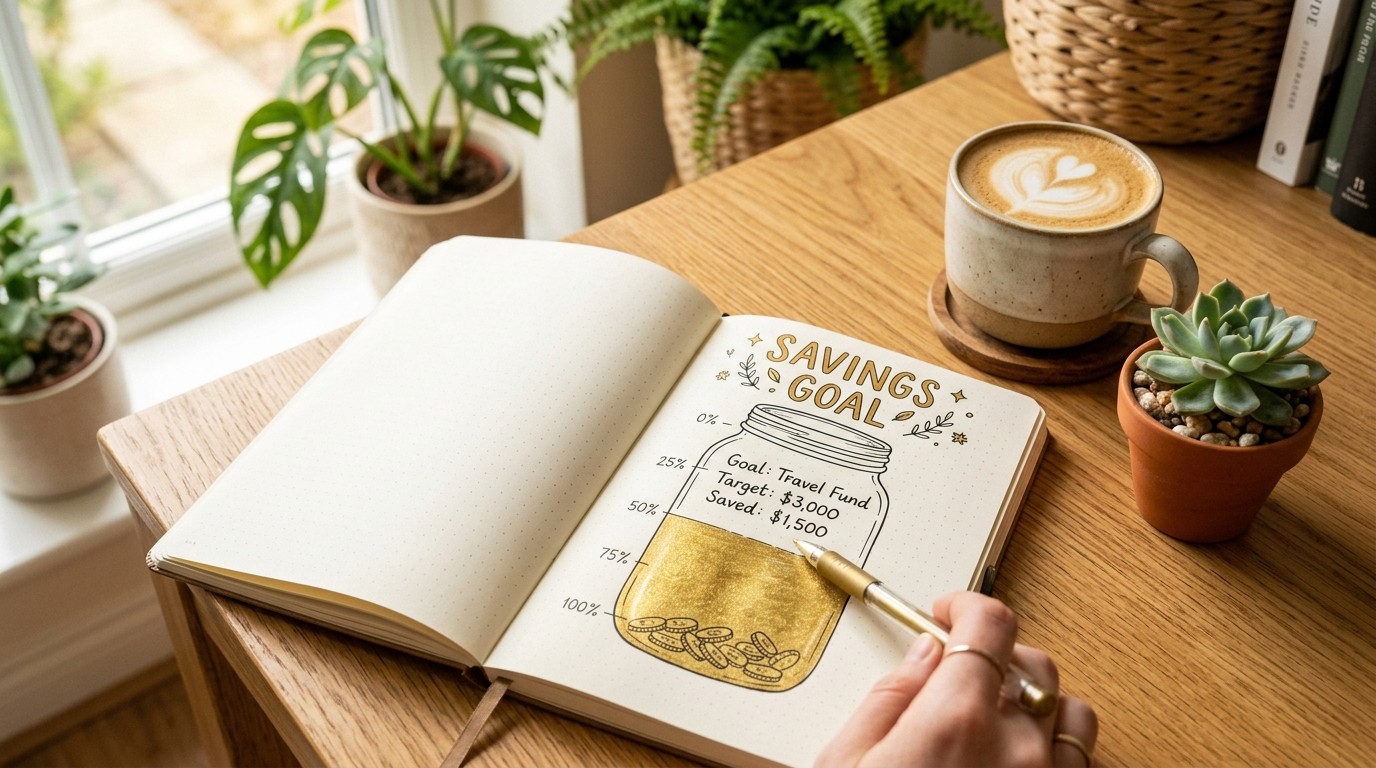
Saving money can feel slow and invisible. I started drawing savings journal ideas using geometric shapes that I color in as I progress. My favorite is the “Jar Tracker.” I draw a large jar on a page and divide it into 20 segments. Each segment represents $500 toward my $10,000 goal.
Coloring in a segment provides a massive dopamine hit. It makes the boring act of saving feel like a game. I used this specific goal budget pages idea to save for a family trip to Japan last year. Seeing the jar fill up kept the kids excited too. We kept the notebook on the kitchen counter so everyone could see our progress.
This method works for any goal. You can draw a house for a house down payment or a car for a new vehicle fund. It turns your DIY budget journal into a visual scoreboard. For more aggressive saving tactics, see my emergency fund guide.
6. The Receipts Envelope Pocket Journal

One of the hardest parts of paper budgeting is keeping track of physical receipts. I solved this by gluing a small envelope to the back cover of my expense notebook. Every time I get a paper receipt, it goes into the pocket immediately. On Sunday evenings, I sit down and log them all at once.
This prevents the “I’ll do it later” trap that kills most DIY budget journal attempts. If the receipt isn’t in the pocket, it doesn’t exist. This habit helped me find $200 in business deductions I would have otherwise missed last year. It is a simple mechanical addition that adds huge value to your budget notebook.
You can buy adhesive pockets or just make your own with cardstock and tape. This transforms your journal into a complete financial wellness hub. If you need help organizing your tax-related expenses, read my financial freedom roadmap for more documentation tips.
7. Habit-Based Spending Trackers

Most budgets focus on the “what,” but a habit budget tracker focuses on the “when” and “why.” I created a grid in my journal to track daily habits like “Made Coffee at Home” or “No-Spend Day.” I use a simple “X” for every day I succeed.
In 2024, I noticed that my “Eating Out” spending always spiked on Wednesdays. I realized it was because I had a late meeting and was too tired to cook. By tracking the habit, I was able to prepare a crockpot meal on Tuesday nights. The habit budget tracker helped me fix the root cause of the overspending.
This is a high-level money management technique. It moves you from passive recording to active behavior change. It is an essential part of any aesthetic budget tracker. To find more habits that save you cash, check out how to save money on groceries.
8. Doodle-Heavy “Fun Spending” Logs

Money shouldn’t always be serious. I have a section in my journal for monthly budget doodles. Every time I spend money on something purely for joy—like a new book or a concert—I draw a little icon of it. It creates a “memory log” of the good times my money provided.
This practice fights the “scarcity mindset” that often comes with strict budgeting. It reminds me that a rich life has nothing to do with money alone, but rather the experiences money can facilitate. Seeing a page full of happy doodles makes me feel wealthy, regardless of the balance.
Using Tombow Dual Brush Pens makes these doodles look professional with very little effort. This is one of those creative budget planner ideas that keeps you engaged for the long haul. If you are feeling stressed about your balances, read how to stop worrying about money for a perspective shift.
9. Goal-Oriented Vision Board Budgeting

I dedicated the first two pages of my 2026 budget notebook to a vision board. I pasted photos of the life I want to build. I included a photo of a quiet garden, a stack of books, and a map of Europe. Under each photo, I wrote the estimated cost to achieve that dream.
Whenever I feel tempted to buy something I don’t need, I look at my goal budget pages. I ask myself, “Do I want this shirt, or do I want the garden?” The visual reminder of my long-term goals makes the short-term sacrifice easy. It provides the financial motivation you need to stay the course.
A budget without a vision is just math. A budget with a vision is a freedom plan. I discuss how to set these high-level targets in my financial freedom roadmap. It is the first step in Creating Wealth.
10. Printable Hybrid Planner

If you aren’t confident in your drawing skills, a printable budget notebook is a great middle ground. I design my own layouts on Canva and print them out. I then tape or glue them into my notebook. This gives me the “clean” look of a printed planner with the flexibility of a journal.
You can find thousands of printable budget notebook designs online. Some focus on debt payoff, while others focus on investing. This allows you to “shop” for the perfect system without committing to a pre-bound book. It is a very cost-effective way to build a DIY budget journal.
In 2026, many creators offer digital downloads that you can customize. This is a great way to support small businesses while improving your financial health. For more on using tech to help your analog life, see my best money apps review.
11. The Debt Thermometer Spread

When you are paying off a large debt, the progress can feel invisible. I use a “Debt Thermometer” in my expense notebook. I draw a large thermometer and mark the total debt at the top and zero at the bottom. Every time I make a payment, I “fill in” the red ink.
I remember when I hit the halfway mark on my car loan. I used a glitter pen to mark the occasion. It turned a painful monthly payment into a celebratory event. This is one of the best budgeting notebook ideas for maintaining momentum during a long payoff journey.
This visual representation of “killing the beast” is highly motivating. Use it alongside the “Debt Snowball” method for maximum effect. I explain the full strategy in how to get out of debt. It is a core part of managing your money.
12. The Weekly Check-in Reflection Page

A budget is more than just numbers; it is a reflection of your life. I leave a blank page at the end of every week for “Financial Reflections.” I write down how I felt about my spending. “I felt guilty about the shoes,” or “I felt proud of the grocery savings.”
In 2025, these notes helped me realize that I spent more money when I was lonely. I was using shopping as a social substitute. This savings journal ideas tactic allowed me to address the underlying emotion. It moved my budget notebook from a tracker to a self-improvement tool.
Self-awareness is the ultimate money life hack. When you understand your triggers, you control your cash. Read how to budget for beginners to see how to incorporate these reflections into your routine.
13. Holiday and Gift Planning Logs

Christmas and birthdays always seem to “surprise” people. In my creative budget planner, I have a dedicated spread for every major holiday. I list every person I need to buy for and set a strict limit. I track the purchases as I go.
This prevents the December panic and the January credit card hangover. By planning in July, I can look for sales and shop with intention. This is a vital savings plan component for families. It ensures that your generosity doesn’t ruin your financial peace.
I also use this page to track DIY gift ideas. A handmade gift often means more and costs less. Check out how to make money on pinterest for creative gift-making ideas that could even become a side hustle.
14. The “No-Spend” Calendar View

I draw a small 31-day calendar at the start of every month. My goal is to mark as many days as possible with a gold star. A gold star means a “No-Spend Day.” This is the ultimate habit budget tracker challenge.
It turns your monthly budget into a game. I found that I would skip a $5 snack just because I didn’t want to lose my “streak” of stars. By the end of the month, seeing a calendar full of gold makes me feel incredibly empowered. It is a simple, visual way to build Better Money Habits.
If you have kids, you can do this together. Whoever has the most stars at the end of the week gets to pick the movie for Friday night. It teaches the whole house about Spending Money Wisely. For more on family finance, see how to budget for beginners.
Comparison of Budgeting Notebook Styles
| Style | Difficulty | Time Required | Best For |
| Minimalist | Low | 10 mins/week | Busy Professionals |
| Bullet Journal | Medium | 30 mins/week | Creative Flexibles |
| Aesthetic/Floral | High | 60 mins/week | Art Lovers |
| Printable Hybrid | Low | 15 mins/week | Precision Seekers |
| Habit-Based | Medium | 5 mins/day | Behavior Changers |
Frequently Asked Questions
What is the best notebook for budgeting?
I recommend the Leuchtturm1917 or Archer & Olive. These notebooks have high-quality paper that won’t bleed when you use highlighters or pens. A dotted grid is usually better than lined paper because it allows you to draw charts and boxes easily. Your budget notebook should be something you enjoy touching and carrying.
How do I stay motivated with a DIY budget journal?
The key is to make it a ritual. Pick a time, like Sunday morning, and have a nice cup of coffee. Don’t view it as “work.” View it as “dreaming on paper.” Using aesthetic budget tracker techniques like stickers or colors also helps. Celebrate when you fill a page or hit a goal. Consistency is more important than perfection.
Can I do paper budgeting if I have a low income?
Absolutely. In fact, it is even more effective. When margins are tight, every dollar needs a name. A minimalist budget layout helps you find the small leaks that are keeping you broke. You don’t need expensive supplies. A 50-cent notebook and a ballpoint pen are enough to start Creating Wealth. Check how to budget for beginners for a low-income roadmap.
Is paper budgeting better than using an app?
For many people, yes. Handwriting slows down your thinking and forces you to confront your choices. An app can feel like a “black box” that does the work for you, which often leads to disengagement. A budgeting notebook ideas approach builds a deep awareness of your money flow. You can always use an app for quick checks and a notebook for deep planning.
What should I include in my expense notebook?
Every transaction, no matter how small. Also include your income, your fixed bills, and your long-term financial goals. Don’t forget to track your “wins,” like a high-yield interest deposit. A complete expense notebook is a full history of your journey to freedom. Read how to get out of debt to see what specific numbers you should prioritize.
Conclusion
Mastering your money in 2026 doesn’t require complex AI or expensive software. It requires a quiet moment and a blank page. By choosing one of these 14 budgeting notebook ideas, you are taking a radical stand for your future. You are choosing to be an active participant in your own success.
Don’t wait for a new month to start. Buy a notebook today. Draw your first box. Write your first number. The path to financial peace is paved with ink and intention. You have the power to change your life, one page at a time.

James Mitchell is the founder and sole creator behind Logic and Liquidity. With a deep passion for both finance and interior design, James manages every aspect of the website—from writing in-depth blog posts to handling strategy, operations, and content creation. His mission is to help homeowners see their spaces through a financial lens, proving that great design is a smart investment.